
Speed bumps and speed mounds are both common traffic speed reduction facilities on roads, their core function being to force vehicles to reduce speed and ensure traffic safety. However, they differ significantly in appearance, deceleration principle, and applicable scenarios, leading to frequent confusion. Correctly distinguishing their characteristics and applicable scope allows for more scientific planning of road speed reduction schemes. Below, we break down the differences between speed bumps and speed mounds from several key dimensions to help you accurately identify their differences.Which is more durable, plastic or rubber traffic cones?
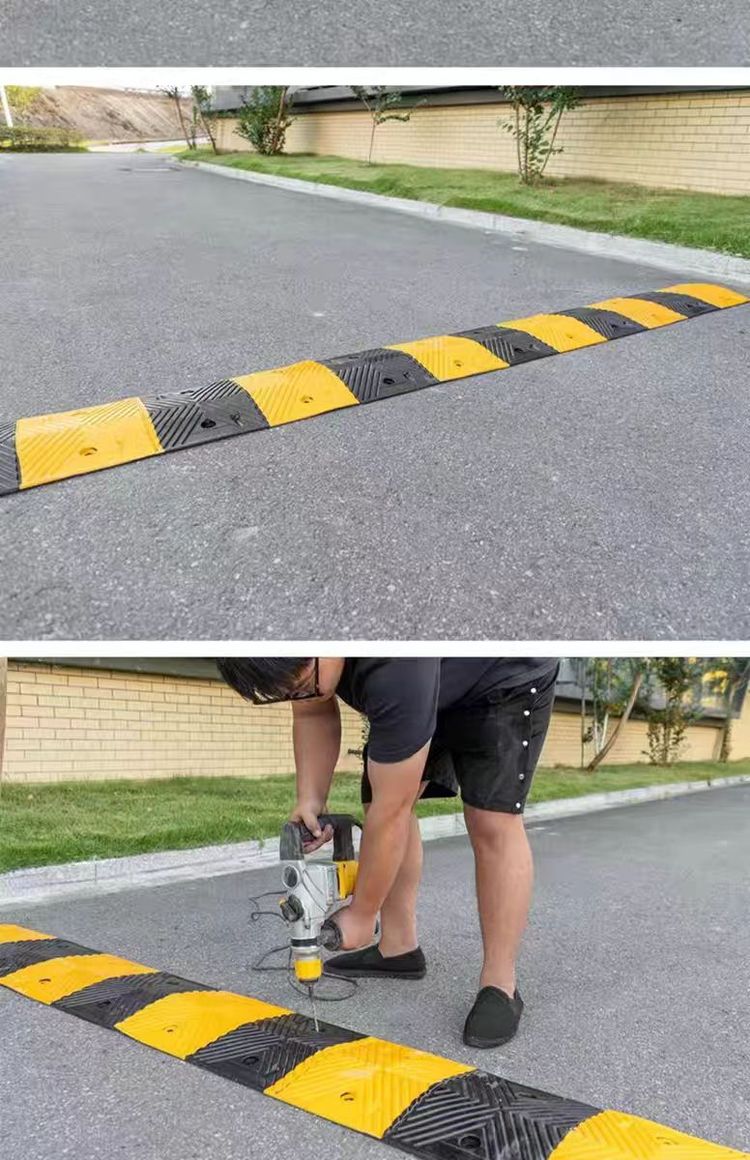
The most obvious difference is their appearance. The structural design differences directly determine their applicable scenarios. Speed bumps are mostly block-shaped structures, commonly trapezoidal or arc-shaped, with a relatively thick overall thickness, generally 5-10 cm, and a narrower width, usually 30-50 cm. The length is adapted to the road width. They are often made of rubber, metal, or concrete, and the surface often has anti-slip textures and reflective markings. Their characteristics include a prominent protrusion, sharp edges, and a strong bumpy feeling when vehicles drive over them. Speed bumps are continuous, rounded protrusions with a streamlined shape. They are relatively thin, typically 3-5 centimeters, but wider, reaching 1-2 meters, and their length matches the road width. They are also primarily made of rubber, asphalt, or concrete, with a smooth surface and no sharp edges, resulting in a relatively gentle bump when a vehicle passes over them.Which is better, rubber speed bumps or concrete speed bumps?
The difference in their deceleration principles determines the difference in the intensity of speed control and the driving experience. Speed bumps rely on a sudden bulge combined with angular impact to achieve deceleration. Due to their high height and narrow width, the tires experience a strong vertical impact when a vehicle passes over them. This noticeable bump forces the driver to actively reduce speed to 10-20 km/h, resulting in a direct and forceful deceleration effect. Speed mounds, on the other hand, rely on a gradual rise combined with continuous force. Their rounded structure allows the vehicle tires to gradually contact the protrusion and slowly rise before smoothly returning to their starting position. The entire process is less impactful, primarily guiding the driver to decelerate by changing the vehicle’s posture and increasing rolling resistance. This typically keeps the speed at 20-30 km/h, resulting in a relatively gentle deceleration effect. The core difference between the two lies in their applicable scenarios, requiring precise matching based on road type, traffic flow, and safety needs. Speed bumps, due to their strong deceleration, are more suitable for installation in areas with strict speed limits and high pedestrian density, such as internal roads of residential communities, school gates, kindergartens, and parking lot entrances. These areas demand extremely high speed control and require a strong bump to alert drivers. Furthermore, speed bumps are often installed on internal roads in factories and warehouses to ensure the safety of personnel and goods. It’s important to note that speed bumps are unsuitable for installation on main roads, bus lanes, and other high-traffic areas, as they can severely impact traffic efficiency and potentially damage vehicle chassis.How many kilograms of weighted sandbags should be placed inside a traffic cone?
Rapid hills, on the other hand, offer gentler deceleration and less damage to vehicles, making them more suitable for installation on secondary roads, side roads, and roads surrounding communities with moderate traffic flow. They effectively control speed without excessively affecting traffic efficiency. Examples include side roads in suburban areas, roads surrounding large communities, and roads around parks, where a balance between deceleration and smooth traffic flow is needed. In addition, speed bumps are also suitable for installation on roads surrounding hospitals, preventing severe bumps from affecting ambulances and other emergency vehicles, ensuring smooth emergency access. Furthermore, due to their continuous arc structure, speed bumps are more suitable for sections requiring smooth deceleration, such as curves and slopes.
Besides the core differences mentioned above, the two also differ in installation, maintenance, and impact on vehicles. In terms of installation, speed bumps are simple to install, requiring only individual pieces to be joined, and damaged sections can be replaced individually. Speed bumps, on the other hand, are mostly cast in one piece or laid out, requiring more installation work and overall repair for maintenance. Regarding the impact on vehicles, long-term driving over speed bumps can cause wear and tear on the vehicle’s suspension system, chassis, and tires; speed bumps, due to their gentler force distribution, cause less damage and are more suitable for long-term use.
In short, the core difference between speed bumps and speed bumps lies in their intended use: “hard deceleration” versus “gentle deceleration.” The choice should be made based on road function, speed requirements, and traffic conditions to avoid incorrect installation and misuse. Scientific and reasonable installation of speed reduction facilities is essential to ensure traffic safety while maximizing road efficiency.