
Speed bumps act as “mini brakes” on the road, forcing drivers to slow down and ensuring pedestrian safety. However, many people struggle with installing speed bumps: are the installation methods different for asphalt and concrete roads? The answer is definitely yes! These two road surfaces are vastly different – one is “soft,” the other “hard,” resulting in significant differences in the installation methods, materials, and even the strength of the speed bumps. Today, we’ll explain the differences in installing speed bumps on these two types of roads in simple terms, so you’ll know how to choose and install them correctly.How many kilograms of weighted sandbags should be placed inside a traffic cone?
First, let’s talk about the installation methods, which is the most important difference. Asphalt roads are relatively “soft,” and can even become sticky at high temperatures. Therefore, a “hot-melt adhesive” method is commonly used for installing speed bumps. Simply put, the speed bump is heated to soften it, then directly applied to the cleaned asphalt road surface, pressed flat with a tool, and firmly adhered after cooling. This method doesn’t require drilling, doesn’t damage the road surface, and is quick; two people can install several in half a day.How to Prevent Traffic Cones from Being Blown Over by the Wind?
Cement pavements are different; they’re tough, brittle yet strong, and hot-melt adhesives simply won’t hold, falling off under pressure. Therefore, installing speed bumps on cement roads requires a “drilling and fixing” method. First, holes are drilled in the speed bump itself, then corresponding holes are drilled in the cement pavement, and finally, expansion bolts are used to firmly lock the speed bump to the pavement. While this method is more cumbersome, it’s incredibly secure, preventing loosening even under heavy vehicle loads.Which type of reflective traffic cone offers the best reflectivity for nighttime construction?
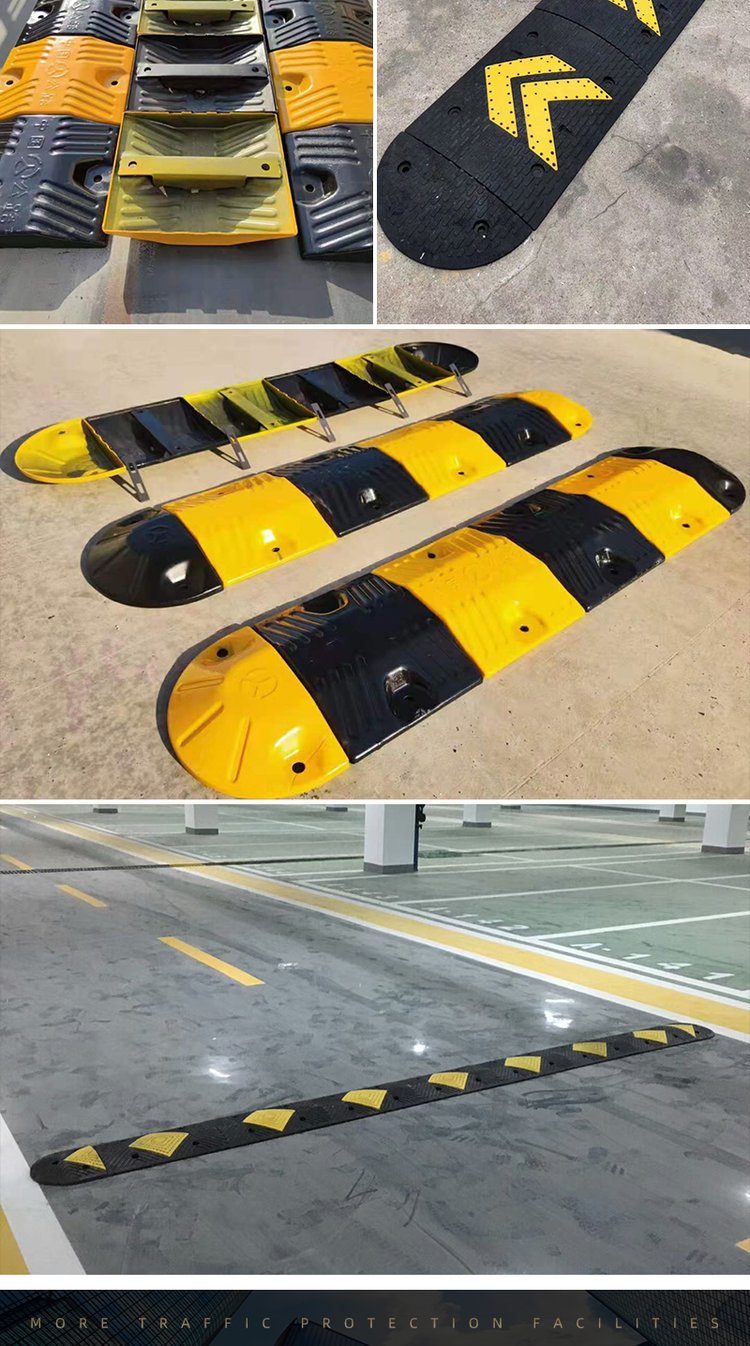
The material used for the speed bumps is also important; they must be compatible with the road surface for optimal performance. Hot-melt speed bumps are suitable for asphalt roads. These have a high degree of adhesion to the asphalt surface, producing less noise when driven over them, and they can “expand” with slight deformations in the asphalt pavement, making them less prone to cracking. Furthermore, yellow or red-and-white striped colors are highly visible day and night, providing excellent warning.
Rubber or metal speed bumps are suitable for cement roads. Rubber speed bumps are elastic, easy to install, and reduce noise from vehicles driving over them, offering excellent value. For intersections or factory areas with heavy truck traffic, metal speed bumps are the better choice, as they are more wear-resistant, pressure-resistant, and last longer. However, it’s crucial to ensure the screws are tightened securely when installing speed bumps on concrete roads; otherwise, heavy vehicles will cause a clanging sound and the bumps may loosen.
The strength and installation difficulty also differ. While installing speed bumps on asphalt roads is faster, their strength is greatly affected by temperature. In summer, high temperatures and sun exposure soften the road surface, potentially causing the speed bumps to shift. In winter, the cold can cause cracks at the adhesive points. Therefore, after installation on asphalt roads, it’s best to avoid heavy vehicle traffic for the first 24 hours to allow for better adhesion.
Speed bumps installed on concrete roads are generally very strong as long as the screws are tightened properly. They are not easily damaged by wind, sun, or heavy vehicle traffic. However, installation is slightly more difficult. Care must be taken when drilling to avoid cracking the concrete surface. After drilling, the holes must be thoroughly cleaned of dust; otherwise, the screws will not be tightened properly, and the speed bumps will still loosen. One more small detail to note: Before installing speed bumps on asphalt roads, clean off any oil and dust, otherwise they won’t adhere properly. On concrete roads, after drilling holes, it’s best to add some waterproof sealant to the holes to prevent rainwater from seeping in and corroding the screws, thus extending their lifespan. Also, regardless of the road surface, the height of the speed bump shouldn’t be too high; 3-5 centimeters is generally sufficient. Too high, and it’s likely to scrape the undercarriage of the car and cause annoyance to other drivers.
Finally, a small suggestion: For asphalt roads near residential areas or schools, choose heat-fused speed bumps, which are quieter and don’t damage the road surface. For national highways or concrete roads in factory areas, choose rubber or metal speed bumps, secured with expansion bolts for durability. Installing speed bumps isn’t about choosing the most expensive; selecting the right type that matches the road surface ensures both effectiveness and peace of mind.