
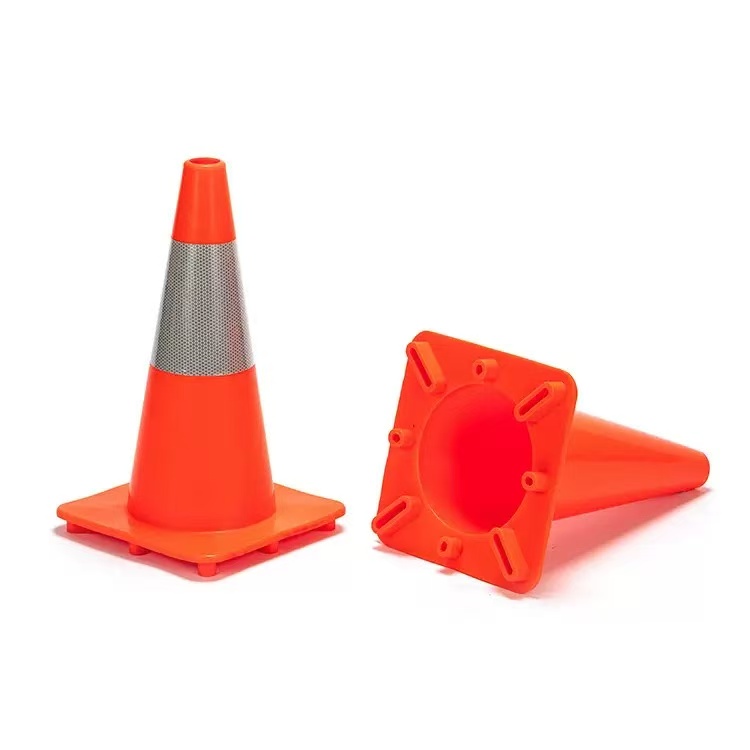
The stability of a traffic cone directly depends on the weight of its weighted sandbags. Appropriate weighting prevents the cone from being blown over by the wind or tipping over after a minor collision with a vehicle, ensuring its warning effect. The weight of the weighted sandbags is not a fixed value; it depends primarily on the height and specifications of the cone, its material, and the environmental intensity of the usage scenario (such as wind force, pedestrian traffic, and vehicle traffic). Adding excessively heavy or light weights will either increase handling costs or compromise stability; precise matching is key.Which is more durable, plastic or rubber traffic cones?
The height of the traffic cone is the basic standard for determining the weight of the weighted sandbags. For small traffic cones (30-45cm high), commonly found in underground parking lots and internal passageways of residential areas—occurring in windless, low-traffic environments—their weight is relatively light (approximately 1-1.8 catties). A weighted sandbag of 1-2 kg is recommended to meet stability requirements, preventing tipping and facilitating easy handling and deployment. Medium-sized traffic cones (50-70cm high) are widely used and suitable for urban secondary roads and short-term construction sections. They weigh approximately 1.5-3.8 catties, and require a matching 2.5-4 kg sandbag counterweight. This weight range can withstand daily wind and minor impacts, making it a mainstream choice that balances stability and convenience.How to Prevent Traffic Cones from Being Blown Over by the Wind?
Large traffic cones (80-100cm high) are mainly used in high-intensity scenarios such as highways, urban main roads, and long-term construction sections. They weigh 3.8-8.3 catties and require a 6-8 kg sandbag counterweight. In these scenarios, strong winds and high vehicle speeds mean that even slight airflow impacts can affect the cone’s stability; the heavier counterweight ensures its long-term stability. Additionally, special scenarios require adjustments to the counterweight: in windy outdoor areas (such as bridges and open suburban roads), add 0.5-1 kg to the corresponding size; in indoor or windless enclosed scenarios (such as underground parking garages), reduce the weight by 0.5 kg to reduce the handling burden.
For purchases, please add the following WhatsApp contact.
Besides specifications and application scenarios, the material of the traffic cone also affects the choice of counterweight. Plastic traffic cones are lightweight, weighing 0.5-1 catties less than rubber cones of the same height, so the counterweight sandbag needs to be 0.5 kg heavier than a rubber cone of the same size. Rubber cones are heavier, so the counterweight can be reduced accordingly. Two details also need attention: first, the counterweight sandbags must be made of waterproof and wear-resistant material to prevent leakage and failure during outdoor use; second, after adding counterweight, ensure the center of gravity of the traffic cone is stable, and the sandbags should be laid flat inside the cone base, not piled on one side to prevent tilting. If the cone base does not have a sealed design, custom-made counterweight bags can be chosen to prevent the sandbags from shifting and falling.
In summary, the weight of the counterweight sandbags for traffic cones can be summarized as follows: 1-2 kg for small 30-45cm traffic cones, 2.5-4 kg for medium 50-70cm traffic cones, and 6-8 kg for large 80-100cm traffic cones. For windy outdoor scenarios, add an additional 0.5-1 kg. The core principle is to match the basic counterweight to the specifications of the traffic cone, then make minor adjustments based on the scene and environment, while also taking into account material differences. A reasonable counterweight ensures the traffic cone can stably fulfill its warning function while also balancing ease of transport and avoiding resource waste.