
When driving or shopping abroad, you’ll always see traffic cones of various colors “standing guard” on the roadside. Red, yellow, blue, and orange—they may look flashy, but each color is actually telling a “secret message”—they are a simple set of traffic signals telling you whether to stop, slow down, or go in a certain direction. Many people only know that traffic cones are used to block the road, but they don’t understand the meaning behind these colors. Today, we’ll explain the meaning of these four colors in plain language.What’s the difference between municipal traffic cones and parking lot traffic cones?
First, let’s talk about the most common orange traffic cone. It’s the most eye-catching of all the traffic cones, and its core meaning is “Caution! Slow Down!” Orange is the most easily seen color of all, and it can grab a driver’s attention at a glance, whether it’s sunny, cloudy, or evening. Overseas, orange traffic cones are almost a “standard feature” in construction areas—when municipal road repairs or road maintenance are being carried out, a row of orange traffic cones will be used to demarcate the work area, reminding drivers to change lanes in advance and slow down. In addition to orange, orange traffic cones are also commonly seen in temporary control zones around schools and at sharp bends on rural roads, all aimed at alerting vehicles and pedestrians to their surroundings.
Now let’s talk about red traffic cones. This color is not to be trifled with; it means “No! Don’t come any closer!” Red is the strongest warning color, and when used on traffic cones, it clearly demarcates a “no-go zone.” Overseas, red traffic cones are commonly seen on completely closed roads—for example, when a road collapse requires emergency repairs, or when a large event temporarily closes the road. A red cone means that no vehicle or pedestrian can enter. Red traffic cones are also used in parking lots; for example, if a parking space is broken or a fire lane is blocked, a red cone signifies “No parking or walking here,” and everyone must detour.How Far Should Speed Bumps Be Installed from Intersections?
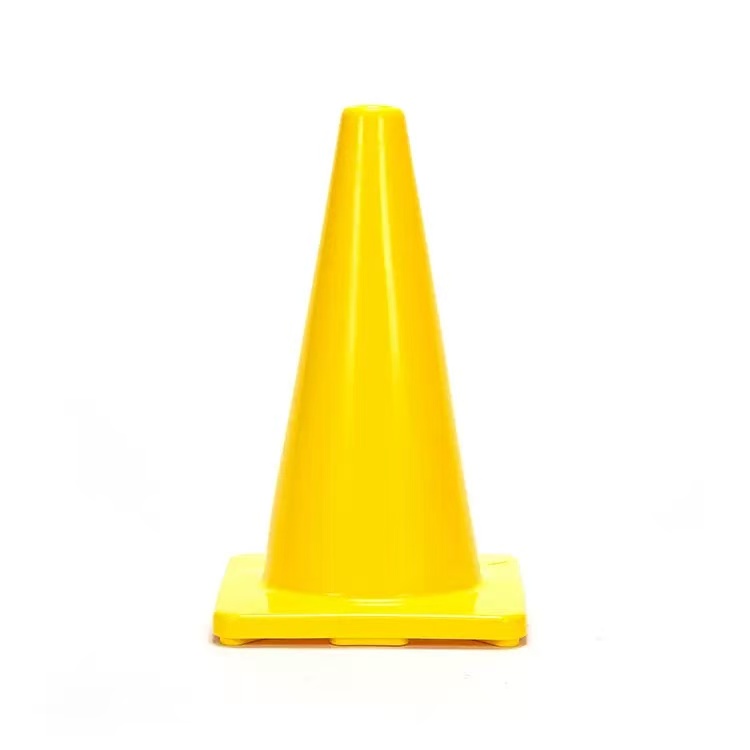
Next are yellow traffic cones, which emphasize “emergency” even more than orange, meaning “temporary danger, get out of the way immediately.” If orange is a “routine reminder,” then yellow is an “urgent notice.” Overseas, yellow traffic cones are commonly used in temporary construction or sudden road malfunctions—for example, if a vehicle breaks down on a highway, traffic police will use yellow cones to create a safety zone around the vehicle to prevent secondary accidents; or when workers are making emergency repairs to potholes, they will also use yellow cones as a warning. Additionally, yellow cones are frequently seen in temporary passageways for large events and in nighttime construction areas because of their high reflectivity, making them particularly bright when illuminated by car headlights at night.What should the spacing of traffic cones be?
Finally, there are blue traffic cones, which act as “guides” among traffic cones, their core function being to “indicate direction and mark special areas.” Blue is not glaring and lacks a sense of warning; instead, it inspires reassurance. Overseas, blue traffic cones are most commonly found in parking lots—for example, in lanes marking accessible parking spaces for people with disabilities, blue cones guide them to find their spots; pedestrian walkways and elevator entrances in shopping mall parking lots are also separated by blue cones to prevent vehicles and pedestrians from mixing. Furthermore, blue cones are used to guide pedestrians in scenic areas and in safety passageways at construction sites, indicating that “it’s safe to go this way.”
Here’s a little trick: remember the core meanings of the colors to avoid confusion: orange = slow down, red = no entry, yellow = emergency avoidance, blue = directional guidance. When encountering traffic cones abroad, don’t panic; the color tells you what to do. For example, if you see a red cone, don’t cross it no matter how rushed you are; if you see an orange cone, slow down and observe your surroundings.
Here are a few common overseas examples to help you understand: On highways in the US, if you see a row of yellow cones, there’s likely a temporary breakdown or construction ahead, so slow down immediately; in European shopping mall parking lots, the lanes guided by blue cones are generally for pedestrians or disabled people; around schools in Australia, orange cones are placed during school drop-off and pick-up times to remind drivers to watch out for children crossing the road.
The color design of traffic cones is actually very thoughtful, conveying traffic information in the most intuitive way, making it easy to understand even without knowing complicated traffic rules. Next time you see these colored traffic cones abroad, pay attention and see if they correspond to the meanings I’ve described. If you’re in parking lot management or road maintenance, choosing the color of the traffic cones is simple; just pick according to your needs—choose orange to remind people to slow down, red to close the road, yellow for emergency repairs, and blue to guide directions.