
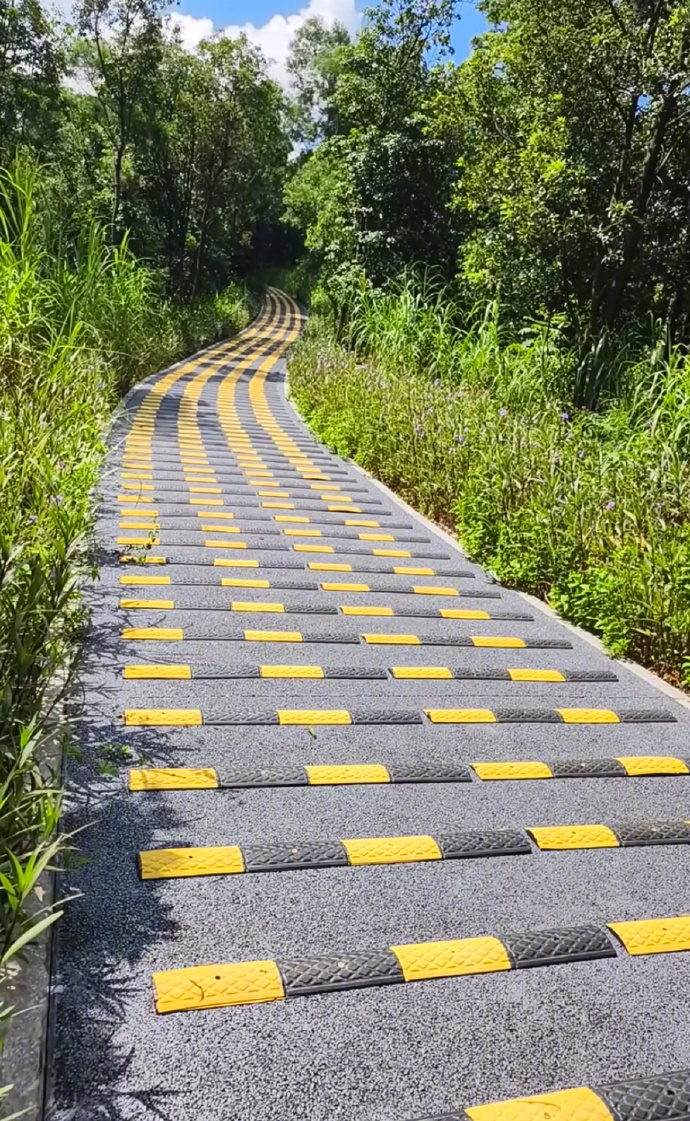
If you’ve driven in residential areas or near schools overseas, you’ve definitely felt the “bump-bump” of speed bumps. They’re great at slowing down cars, but have you ever wondered why some speed bumps are close together and others are far apart? It’s not a random choice—there’s an ideal distance between them, and it all depends on where they’re installed. Today, let’s talk about this with plain words, no confusing terms.The difference between installing speed bumps on asphalt and concrete roads is surprisingly significant!
First, let’s start with the most common scenario: residential areas. In neighborhoods where kids play on the streets and people walk their dogs, the ideal distance between speed bumps is 3 to 5 meters. Why? Because these areas usually have a speed limit of 20 to 30 km/h. If the bumps are too close—like less than 3 meters apart—drivers will have to crawl at a snail’s pace, which is annoying. If they’re too far—more than 5 meters—drivers can speed up between them, making the speed bumps useless. 3 to 5 meters is just right: it keeps cars slow enough without frustrating drivers.
Next, school zones or areas with lots of kids (like near playgrounds). Here, safety is the top priority, so the distance needs to be shorter—2 to 3 meters. School zones often have a speed limit of 15 to 20 km/h. Shorter spacing means drivers can’t pick up speed at all. Every time they pass a bump, they have to stay slow. This protects kids who might run across the street suddenly. You’ll also find this spacing near daycares or pedestrian crosswalks in busy areas.The Difference Between Installing Speed Bumps on Asphalt and Concrete Roads is Surprisingly Big!
For commercial areas, like shopping mall parking lots or small business districts, the ideal distance is 5 to 8 meters. These places have more cars, but the speed limit is still low (around 25 to 30 km/h). A longer distance than residential areas lets cars move a little faster, which reduces traffic jams. But it’s still short enough to stop drivers from speeding. Imagine a parking lot with speed bumps 10 meters apart—drivers would zoom between them and hit pedestrians or other cars easily.How long do the batteries in traffic cones with LED flashing lights last?
Another scenario: rural roads or country lanes. Sometimes these roads have speed bumps near farms, small towns, or crossroads. Here, the ideal distance is 8 to 12 meters. Rural roads usually have higher speed limits (40 to 50 km/h) before the speed bumps. Longer spacing gives drivers time to slow down gradually instead of slamming on the brakes. If the bumps are too close here, it can cause accidents—especially for trucks or large vehicles that take longer to slow down.
There’s a small trick to remember: the lower the speed limit, the shorter the distance between speed bumps. It’s like training a dog to walk slowly—you tug the leash more often if you want it to stay close. For speed limits below 20 km/h, go for 2 to 3 meters. For 20 to 30 km/h, 3 to 8 meters. For 30 to 50 km/h, 8 to 12 meters. This rule works for most places overseas.
Don’t forget about local traffic rules. Different countries have small differences. For example, in the US, most cities require speed bumps in residential areas to be 3 to 5 meters apart. In European countries like Germany or France, the distance is often 4 to 6 meters for the same areas. Before installing, it’s a good idea to check the local rules—you don’t want to put them too close or too far and get fined.
Here’s a fun observation: next time you drive past speed bumps overseas, count the distance between them. You’ll find that they match the speed limit of the area. If you’re someone who manages roads or parking lots, picking the right distance is easy. Just ask two questions: What’s the speed limit here? How many pedestrians or kids are around? Answer these, and you’ll get the ideal distance.