
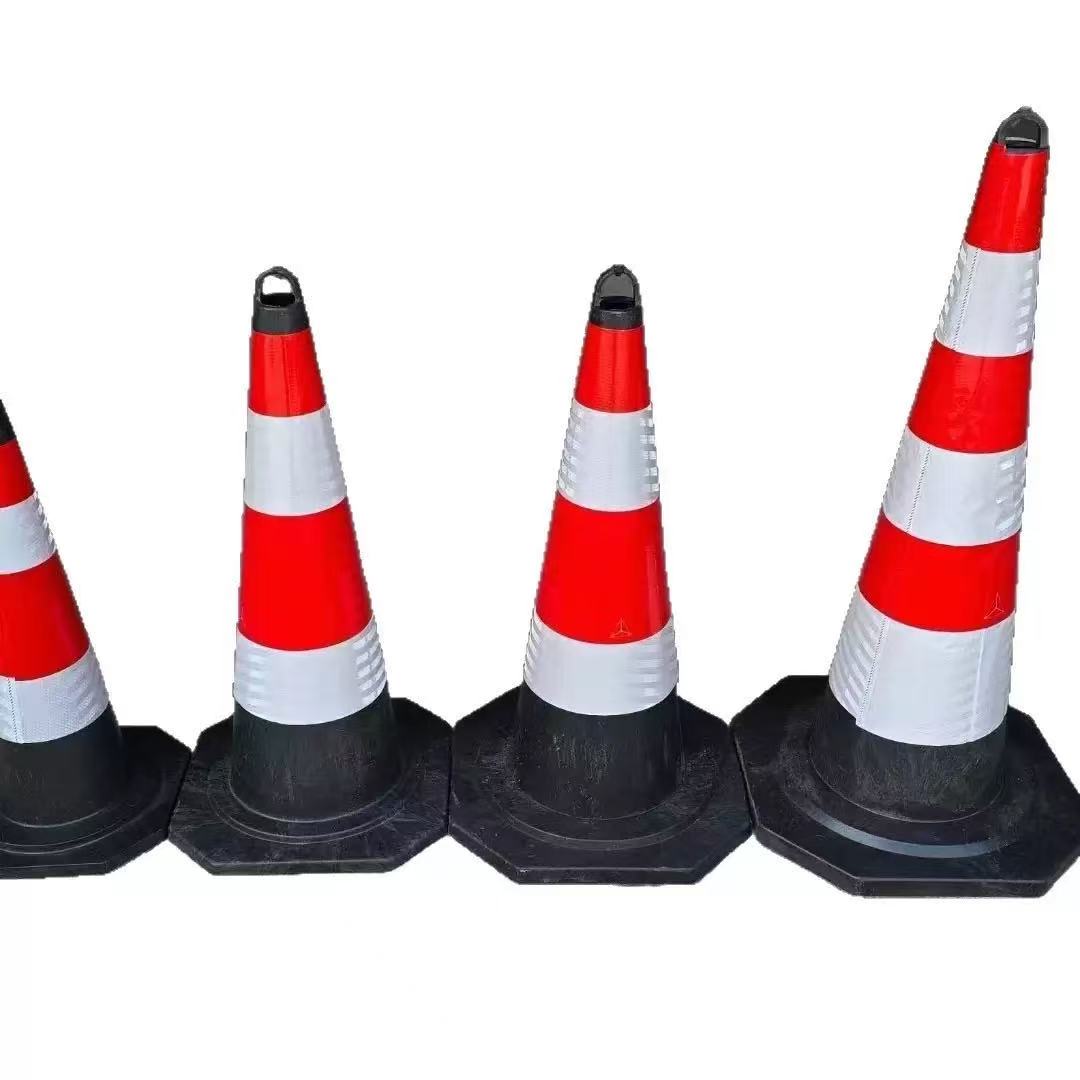
As a core facility for temporary traffic warning and guidance, the spacing of traffic cones directly affects the warning effect and traffic safety. Too close a spacing wastes resources and disrupts traffic flow; too far apart a spacing fails to create a continuous warning and guidance strip, easily leading to insufficient driver anticipation and accidents. There is no uniform standard for traffic cone spacing. The core logic is “adapting to the vehicle speed of the scenario and ensuring the continuity of the warning,” which needs to be determined comprehensively based on factors such as the usage scenario, traffic flow, and road conditions. Below is a detailed analysis of the spacing standards for different core scenarios, key factors affecting spacing, and practical placement points to help you accurately control the spacing of traffic cones.Which is better, rubber speed bumps or concrete speed bumps?
Temporary construction/repair scenarios on urban roads: Adapting to low-to-medium speed traffic, the spacing needs to balance warning and traffic efficiency. The recommended spacing for traffic cones on urban main roads (speed 40-60 km/h) is 10-15 meters. These roads have high traffic volume, requiring continuous traffic cones to form a clear warning and guidance strip, giving drivers sufficient time to change lanes and slow down; at the same time, avoiding excessive spacing that could cause traffic congestion. For urban secondary roads and community roads (speed ≤ 30km/h), the spacing between traffic cones can be shortened to 5-10 meters. On these roads with slow speeds, closer spacing allows for more precise delineation of temporary traffic areas, especially suitable for narrow, one-sided construction scenarios, preventing vehicles from scraping the construction area. If the construction area is near a pedestrian crossing or intersection, transitional traffic cones should be placed starting 50 meters from the intersection, gradually reducing the spacing to 3-5 meters to enhance warning and guidance effects.Which type of reflective traffic cone offers the best reflectivity for nighttime construction?
For highway/expressway construction scenarios: To accommodate highway traffic, the spacing needs to be extended to ensure sufficient time for prediction. On highways (speeds 80-120 km/h), traffic cone placement should follow the principle of “long-distance warning and gradual transition.” In the warning zone (2000 meters ahead of the construction area), the cone spacing should be 50-100 meters to deliver early warning signals through sparse cones. In the transition zone (500-2000 meters ahead of the construction area), the spacing should be reduced to 20-30 meters to guide vehicles to gradually change lanes to safe lanes. Around the construction area (core warning zone), the spacing should be further reduced to 10-15 meters to clearly delineate the construction area from the traffic area. On expressways (speeds 60-80 km/h), cone spacing can be adjusted accordingly. The spacing in the warning zone should be 30-50 meters, and the spacing between the transition and core areas should be 15-20 meters to ensure sufficient reaction time for vehicles traveling at high speeds.How Far Should Speed Bumps Be Installed from Intersections?
In temporary traffic control/diversion scenarios: adjust spacing as needed, prioritizing clarity of guidance. For temporary traffic control within residential areas and parking lots (vehicle speed ≤ 20km/h), a cone spacing of 3-5 meters is recommended. These scenarios involve narrow spaces and high pedestrian traffic; closer spacing allows for precise guidance of vehicles to detour and park, preventing congestion or minor collisions. For temporary traffic diversion around large events (such as exhibitions and sporting events), if main roads are involved, the spacing should follow urban main road standards (10-15 meters); if secondary roads, the spacing should be 5-10 meters. Additionally, additional cones (2-3 meters apart) should be placed at diversion intersections to enhance traffic guidance. For temporary traffic control during peak hours in schools and commercial areas, a cone spacing of 3-5 meters, combined with reflective strips or warning lights, clearly demarcates pedestrian and vehicle lanes to ensure traffic order.
In accident scenes/emergency rescue scenarios: rapid deployment with short spacing to build a robust safety perimeter. At the scene of a regular road accident, traffic cones should be placed 50-100 meters behind the accident vehicle, spaced 5-10 meters apart, forming a continuous protective barrier to prevent secondary accidents. If the accident scene occupies a lane, additional traffic cones should be placed outside the protective barrier, spaced 3-5 meters apart, to expand the warning range. At the scene of a highway accident, the warning distance needs to be extended to 1500-2000 meters, with traffic cones spaced 50-100 meters apart in the warning area and 5-10 meters apart in the core protection area (around the accident scene). Warning lights and warning tape should be used in conjunction to enhance the warning effect at night or in inclement weather. In emergency rescue scenarios (such as ensuring fire lanes and ambulance access), the spacing between traffic cones can be shortened to 2-3 meters to quickly open temporary passages and ensure smooth passage for rescue vehicles.
Key supplementary factors affecting the spacing of traffic cones: First, weather and lighting conditions. In low-visibility scenarios such as rain, fog, and nighttime, the spacing should be shortened by 20%-30%, and reflective cones or warning lights should be used to improve visibility. Second, cone type. Larger cones (height ≥ 70cm) have a wider warning range, so the spacing can be appropriately extended; smaller cones (height ≤ 50cm) have a limited warning range, so the spacing needs to be shortened. Third, road slope and curves. On downhill sections and along continuous curves, vehicle braking and steering become more difficult, so the cone spacing needs to be shortened by 10-20% to enhance warning and guidance in advance.
Practical precautions for traffic cone placement: When placing cones, they should be evenly distributed in a straight line along the edge of the road or the boundary of the construction area to avoid tilting or misalignment that could affect the guidance effect. If guidance is needed on curves, the cone spacing needs to be adjusted according to the curve radius; the smaller the radius, the shorter the spacing (3-5 meters is recommended) to ensure a clear guidance trajectory. After placement, the traffic cones must be checked for stability to prevent them from tipping over due to wind or vehicle collisions. They should also be removed promptly after construction or traffic control measures are completed to avoid disrupting normal traffic.
In summary, the core principle of traffic cone placement spacing is that “vehicle speed determines the basic spacing, while the specific scenario and environment require adjustments.” From 3-5 meters in low-speed scenarios to 50-100 meters in high-speed scenarios, precise adaptation to actual traffic conditions is necessary. Following scientific spacing standards ensures that the traffic cones effectively serve their warning and guidance functions while maintaining smooth traffic flow and avoiding resource waste and safety hazards. If unsure about the appropriate spacing for a specific scenario, refer to relevant regulations from local traffic management departments or conduct on-site trial placements to ensure compliance and practicality.